My work in digital scholarship has taken me through several different areas. As the Ethics intern for Carleton’s Digital Scholarship program, I’ve done research on data privacy and the laws surrounding it, the impact of technology on democracy, and how digital tools implement analog ideas to solve day-to-day problems. I’ve also taken classes on digital media and its impact on communities, and the ways interactive narratives and stories can guide us on
R&D: Researching and Dossiers
The bulk of my professional experience in the digital humanities has been in the field of digital ethics, as I stated above. While I was assigned to various projects across multiple departments as the Ethics intern at Carleton, the core of my work focused on research and communications — namely, blogging.
I would research a particular topic relevant to technology or ethics (preferably both), then write a short, clear summary of my findings in a way that would help Carleton’s community. The topic that came up most frequently was data privacy: in the context of Zoom, the California Consumer Privacy Act, the usage of smartphone apps in the 2020 Iowa caucus… the list goes on.
This practice of research and writeup wasn’t always done for the intern blog in particular (I also made a zine on Carleton’s social media culture, and a handout about archival of digital projects), but part of my goal was to keep my work publicly informative, so all the work that was fit to print ended up on the blog. You can read my posts here! Or, if you’d like a curated selection, I’ve linked a few specific ones on this page.
Conceptualizing the Digital

Image source here.
Digital Cinema Cultures was a CAMS class I took with Dimitri Pavlounis in the fall of 2017, and my introduction to the digital humanities as a concept. Throughout the course we reflected on how the technology we use to communicate shapes what we say, and how we think about communication influences technology.
For example, while handsets for phones and paper envelopes obviously still exist, their functionality has nothing to do with the way smartphones and email are designed. So why do apps for calling and emailing use icons which invoke handsets and envelopes? Does it say something about sentimentality, or is it a practical visual shorthand that no longer needs to be connected to the items that inspired it? Maybe it’s both! Who knows?
Similarly, analog mediums (pen and paper, photographic film, paints) are affected by the changes you make — as in, if you erase something on your paper, there’s a mark where your pencil pressed. Digital mediums aren’t; they’re modular, which means they can easily be changed and rearranged, and the changes you make aren’t preserved in the final artifact. This can be a good thing or a bad thing — no judgement here. But it definitely affects the way we think about physical processes versus digital processes.
Those examples are a little reductive, obviously, but I can’t squeeze an entire semester’s worth of learning into one page of this site. The point is: how we think about technology matters. How we think about how we think about technology matters. How we communicate… you get the picture. I actually distilled some of these thoughts into my final project for Digital Cinema Cultures, a short radio drama titled AI.exe. If you’d like to listen to it, it’s on display over here, on my Sound & Video page!
Political Narratives through Technology
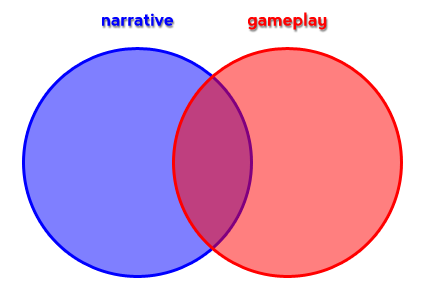
Image courtesy of Luderacy.
In the winter of 2018, I took Video Games & Identity, another CAMS class with the same professor who taught Digital Cinema Cultures. This course was also about how technology shapes the way we think, but from a slightly different angle: here, we talked about how participation shapes behavior.
To simplify this a little, a book that wants to make an ideological point makes its point to you; you can’t change anything about the words printed on the page, and you aren’t an active participant in the narrative it’s giving you. But a game (any game, not just video games!) that wants to make an ideological point — well, the whole part of a game is that you play. You are an active part of how the game plays out… sort of. (Depending on what options the game designers allow you.)
Video Games & Identity got me thinking about the power of digital projects, which are interactive and can be distributed en masse in a really unique way. Games are one such type of project, but exhibitions are another way of immersing a person in the topic of your choosing. Data exploration projects are another.
And there’s no inherent ethical stance to playing a game, any more than there is to designing it. But we bring baked-in assumptions to everything we create, which means that anyone who participates in a narrative we create gets to spend a while in our shoes, learning from us, evaluating our choices and being as complicit or resistant as the game’s constraints allow.
That got a little dark. If you’d prefer, you can take a look at my final project for Video Games & Identity, inTransigent, described here on my Coding page, and playable here on this very site!
